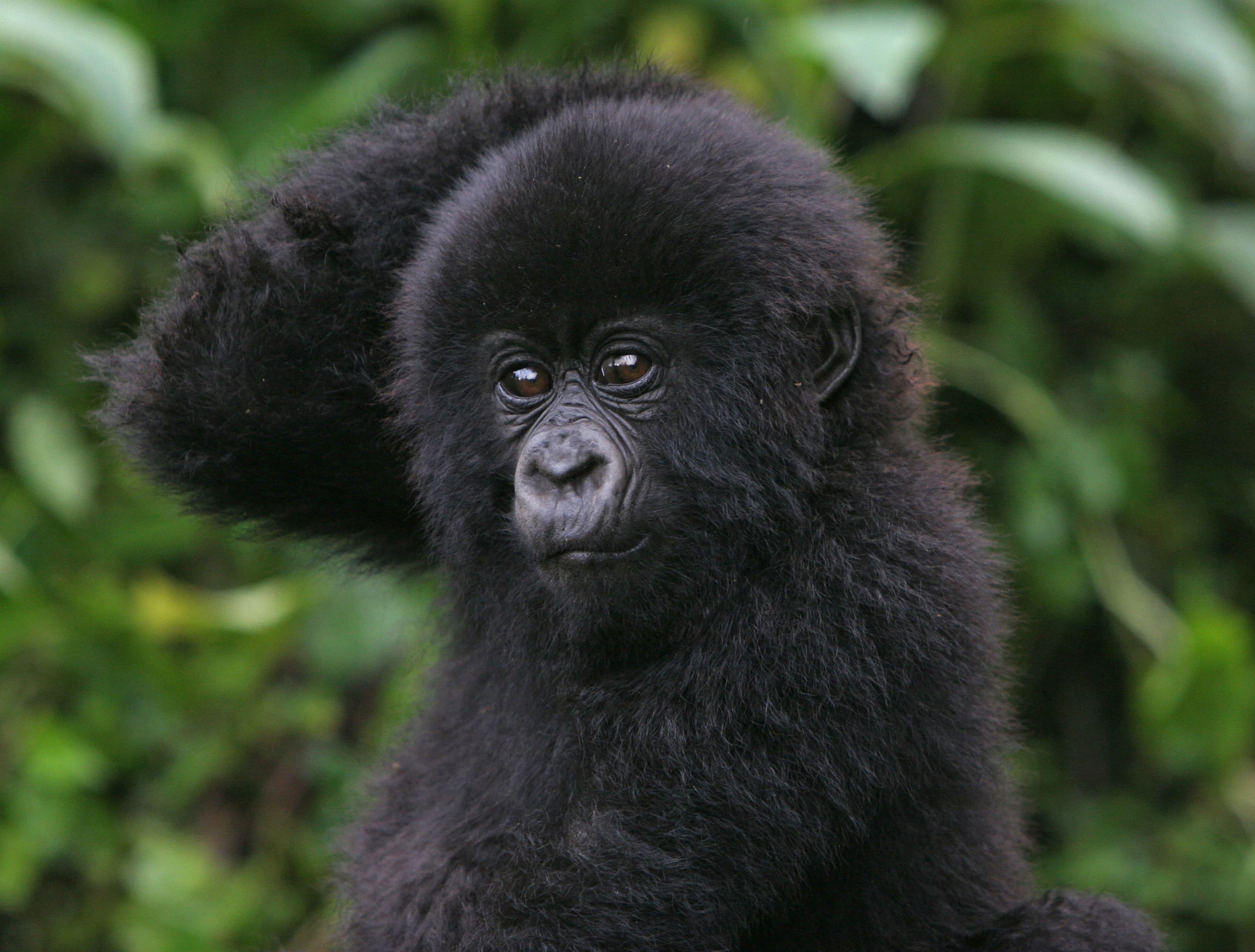
Silverback Gorilla Guide
Who leads a gorilla family, how he behaves, and where you can sit an hour away from one.
What is a silverback gorilla?
A silverback is a fully adult male gorilla. Somewhere around the age of 12, the hair across a male's back and hips turns a silvery grey, and that saddle of silver gives him his name. Younger males, roughly 8 to 12 years old, are called blackbacks: already big and strong, but not yet mature.
In the wild, the silverbacks most travellers meet are mountain gorillas, a subspecies of the eastern gorilla. Only a little over 1,000 remain, living in two populations: the Bwindi forest of south-western Uganda and the Virunga volcanoes shared by Uganda, Rwanda and the DR Congo. Decades of protection have made them one of the few great apes whose numbers are growing, and the IUCN moved them from Critically Endangered to Endangered in 2018.
How a silverback leads his family
Gorillas live in stable family groups, typically around 10 animals, though some are much larger. Each group is led by a dominant silverback, and larger families may include one or more subordinate silverbacks as well.
- He decides the day. The group follows him when it is time to move, feed or rest, and builds its night nests near his.
- He keeps the peace. Squabbles among females and youngsters are usually settled with a look, a grunt or a short display rather than a fight.
- He protects the group. Faced with a rival male or a perceived threat he will stand, roar, beat his chest and charge, and he will fight if he has to.
- He is surprisingly gentle with infants. Young gorillas often play around and on a resting silverback, and orphans are sometimes cared for by him.
Silverback gorilla facts
Size and strength
An adult male mountain gorilla typically weighs around 150 to 200 kg (330 to 440 lb), about twice the size of a female, and stands roughly 1.5 to 1.8 m tall when upright. His arm span can exceed his height.
Diet
Mountain gorillas are almost entirely vegetarian: leaves, stems, shoots, roots, bark and some fruit, with the odd ant or other insect. A big male may eat 20 kg or more of vegetation a day, which is why so much of a trek is spent watching gorillas feed.
Chest beating
The famous chest beat is communication, not aggression by default. Cupped hands make a hollow drumming sound that carries through the forest and tells rivals and females how big and strong the beater is.
Lifespan
Wild gorillas usually live around 35 to 40 years.
Are gorillas monkeys?
No. Gorillas are great apes. Unlike monkeys they have no tail, and they share the great ape family with chimpanzees, bonobos, orangutans and humans. Uganda is one of the few places where you can see mountain gorillas, chimpanzees and several species of monkey on one trip.
Where to see silverback gorillas
Every habituated gorilla family visitors can trek to is led by a silverback, so any gorilla permit is a chance to spend an hour with one.
- Bwindi Impenetrable National Park, Uganda. Roughly half of all mountain gorillas live here, trekked from four sectors: Buhoma, Ruhija, Rushaga and Nkuringo. Permits cost USD $800 for foreign non-residents in 2026. See our Uganda gorilla trekking guide.
- Mgahinga Gorilla National Park, Uganda. Uganda's slice of the Virunga volcanoes, with one habituated family and golden monkeys too.
- Volcanoes National Park, Rwanda. About two to two and a half hours by road from Kigali, with permits at USD $1,500. See Rwanda gorilla trekking.
Comparing costs? Our gorilla trekking cost guide breaks down permits and safari prices in both countries.
Meeting a silverback: the rules
- Trekkers must be at least 15 years old.
- A maximum of 8 visitors may visit each family per day, for one hour.
- Keep at least 7 metres (about 23 feet) from the gorillas.
- Do not trek if you have a cold, flu or other illness: gorillas catch human diseases.
- If the silverback displays or mock-charges, stay still, crouch down, avoid eye contact and follow your ranger. Never run.
Gorilla trekking tours
Ready to meet one? These journeys include gorilla trekking permits and expert guiding:
- 4-Day Gorilla Signature Safari, Uganda
- 5-Day Gorillas and Golden Monkeys Tour, Uganda
- 5-Day Gorilla Tour, Rwanda
- 13-Day Uganda and Rwanda Safari Combo
Or plan a tailor-made gorilla safari with our team in Kampala, Kigali and Gurnee, Illinois.
Frequently asked questions
What is a silverback gorilla?
A silverback is an adult male gorilla, usually 12 years or older, named for the saddle of silver-grey hair that grows across his back as he matures. The dominant silverback leads his family group.
Are gorillas monkeys?
No. Gorillas are great apes, not monkeys. Apes have no tail, larger brains and a more upright build. Gorillas belong to the same family as chimpanzees, bonobos, orangutans and humans.
How big is a silverback gorilla?
A wild adult male mountain gorilla typically weighs around 150 to 200 kg (330 to 440 lb), roughly twice the weight of an adult female, and stands about 1.5 to 1.8 m tall when upright.
Is it safe to be near a silverback?
Yes, with habituated families and trained rangers. Visitors keep at least 7 metres away and follow the ranger's instructions. If a silverback displays or mock-charges, stay still, crouch, look down and never run.
Where can I see silverback gorillas in the wild?
Mountain gorillas live only in Bwindi Impenetrable and Mgahinga Gorilla national parks in Uganda, Volcanoes National Park in Rwanda and Virunga National Park in the DR Congo. Every habituated family has at least one silverback.